Mowing solar parks: professional vegetation management for photovoltaic ground-mounted systems
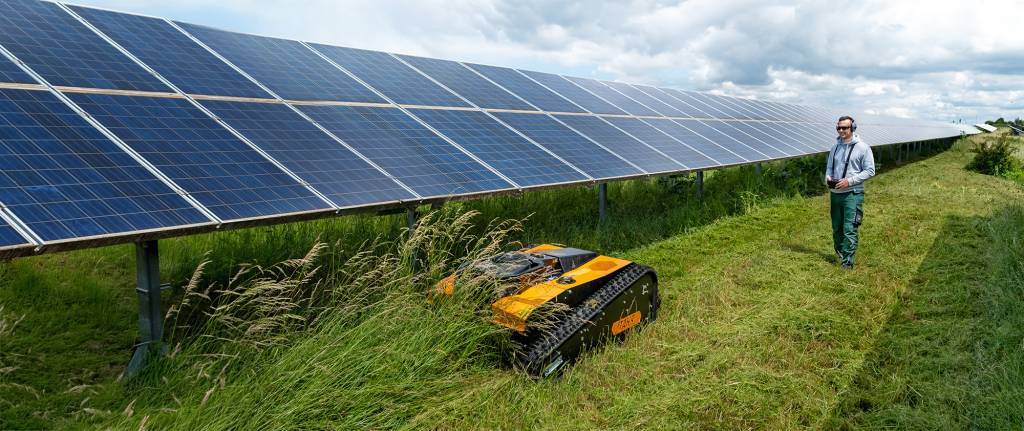
Photovoltaic ground-mounted systems generate renewable energy on land that must remain accessible, manageable and ecologically valuable. That is the challenge: excessive vegetation can block service paths, overgrow fence lines, make technical components harder to reach and, depending on the solar park layout, shade the lower section of solar panels. Overly intensive mowing increases maintenance costs and weakens the ecological value of the site.
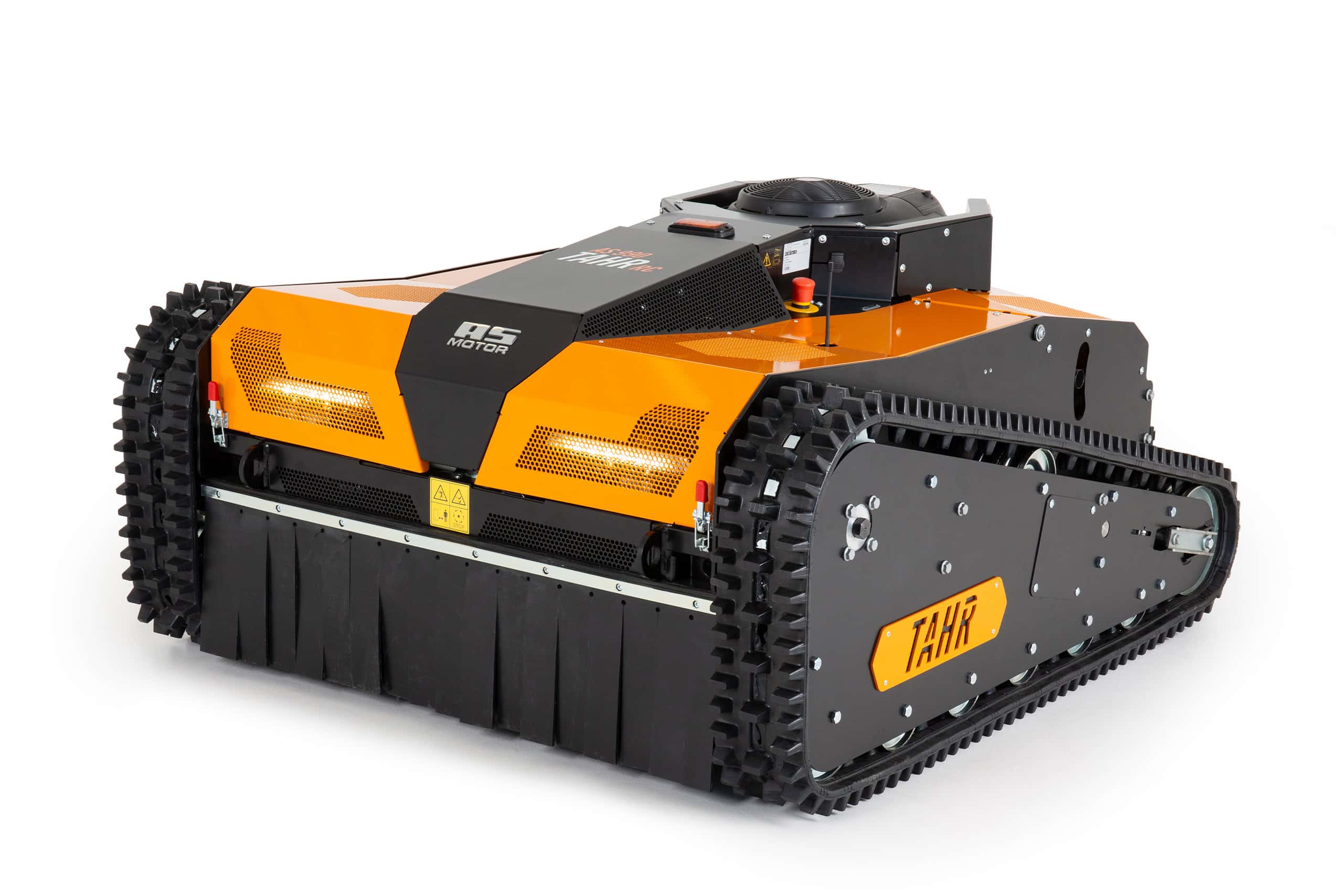
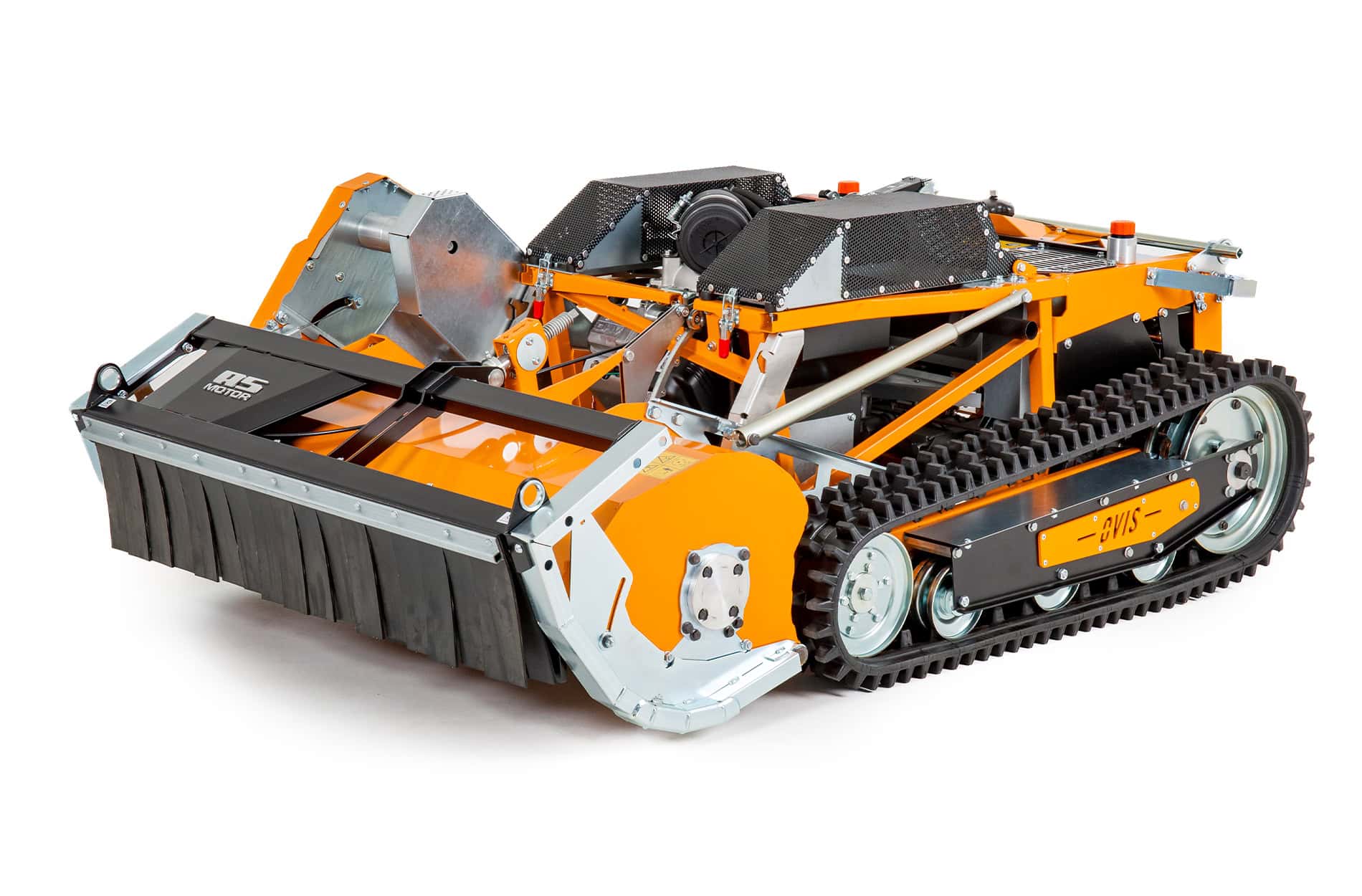
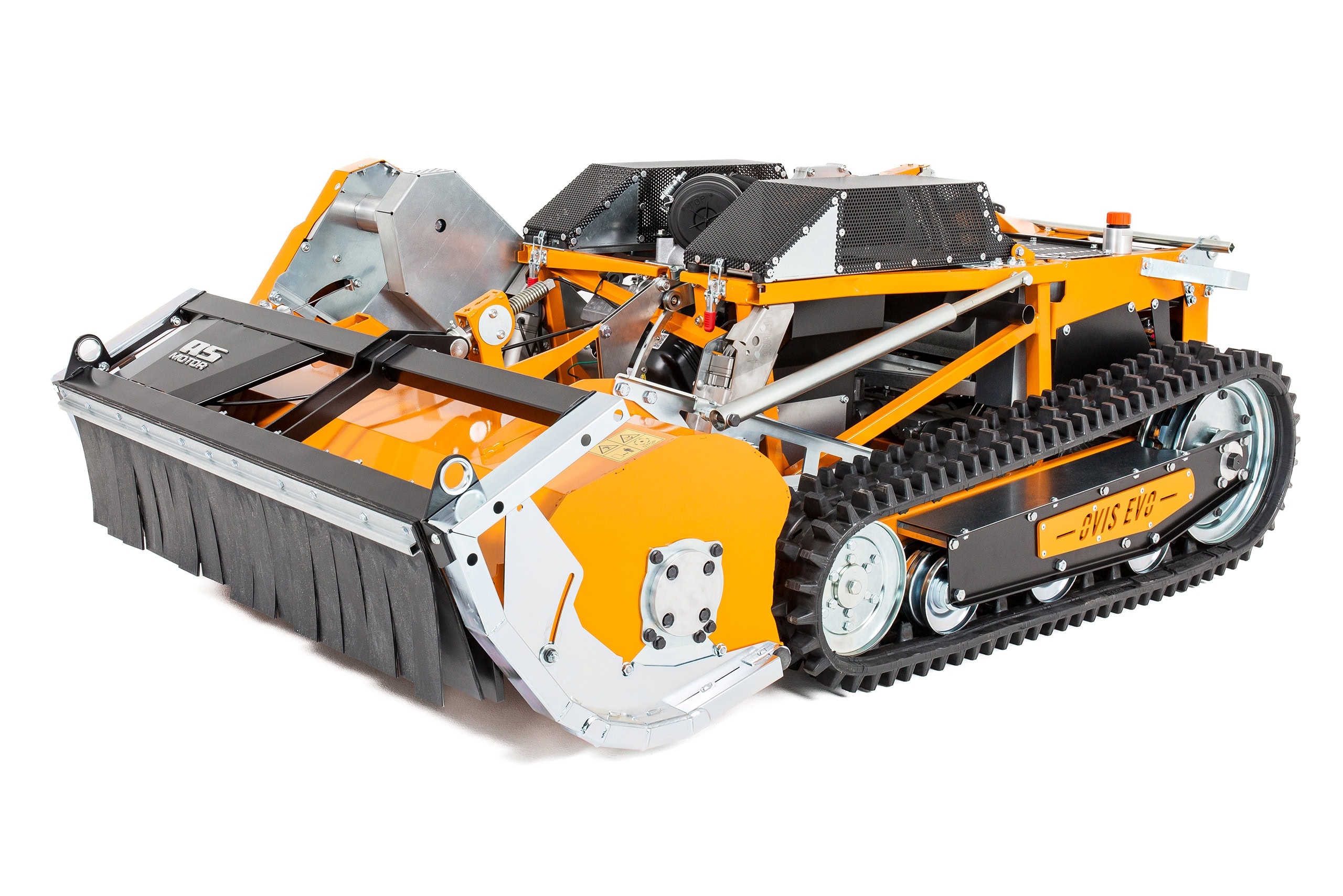
Solar park vegetation management is therefore part of technical operations management. It connects energy yield protection, occupational safety, area performance, biodiversity and predictable maintenance costs. AS-Motor offers professional mowers for high grass, hard-to-access areas, steep embankments and narrow module rows. With compact remote-controlled tracked mowers such as the AS 1000 Ovis RC, AS 1000 Ovis EVO RC and AS 990 Tahr RC, solar parks can be maintained efficiently, including areas where conventional machines reach their limits.
Book a free on-site demonstration
See the machines working on your own site, before you decide
Tell us about your solar park and we will arrange a demonstration with your nearest AS-Motor specialist dealer. You will see how the machines handle your vegetation, your slopes and the clearance under your module rows, and get a straight assessment of which model fits the site. No cost, no obligation.
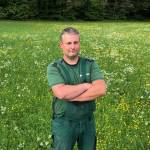
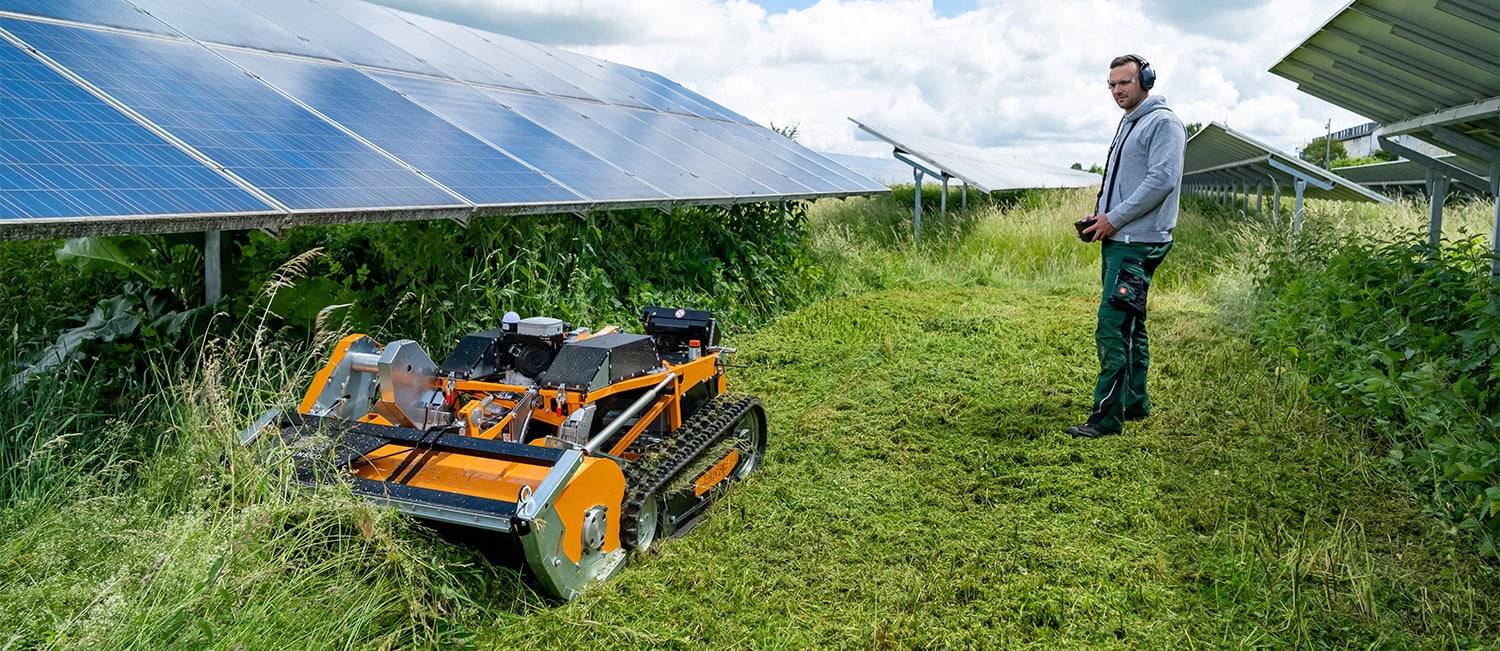
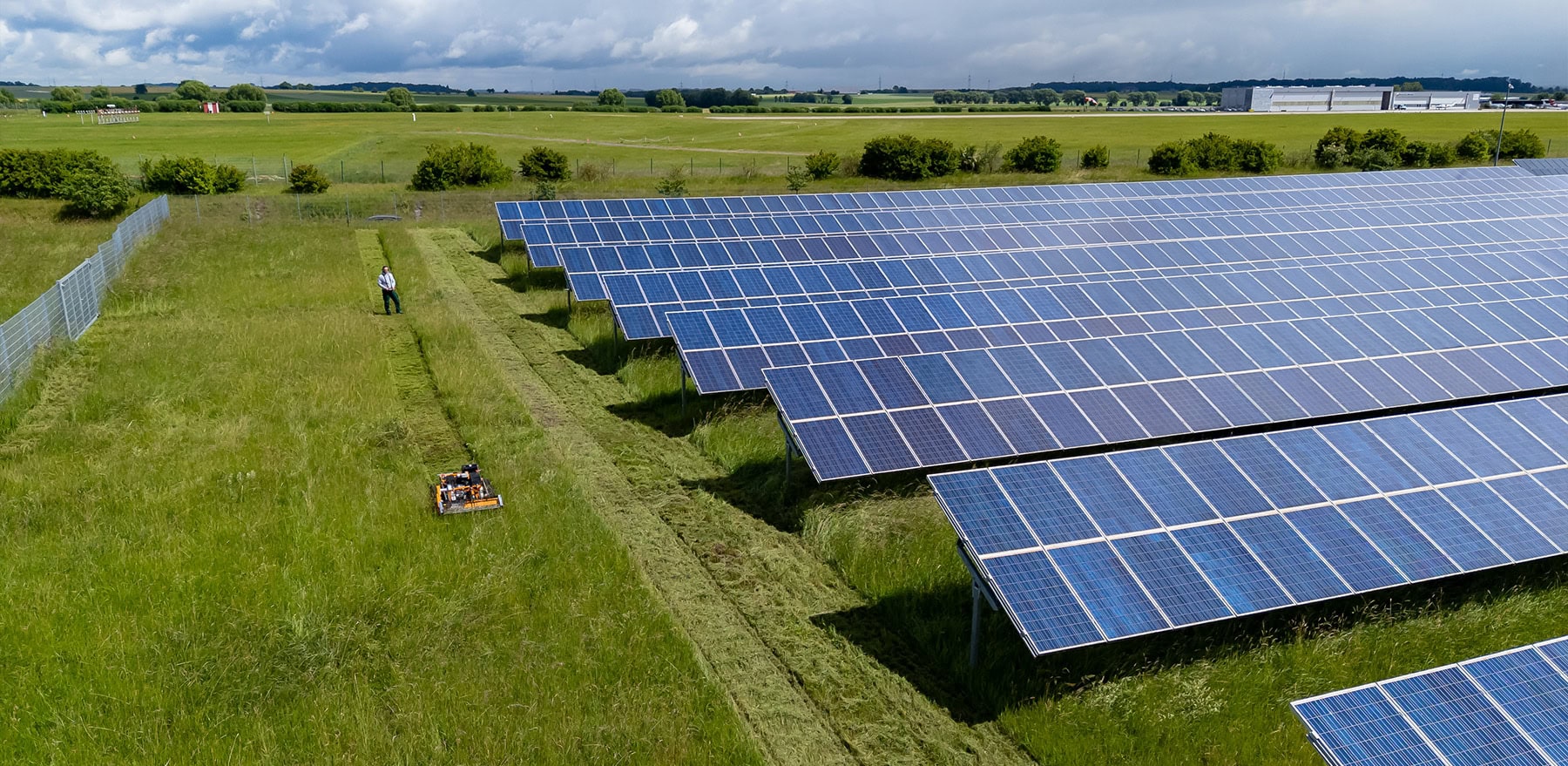
As a “partner for land and ground”, Harald Ernstberger and his team specialise in maintaining solar parks and operate across Germany. Twice a year, they mulch the areas between thousands of solar panels in Germany. The vegetation there is correspondingly high, usually more than half a metre, and often mixed with wild herbs and all kinds of scrub. Solar park sites are also often far from easy to mow: some are uneven, while others include demanding slopes.
Why vegetation management is part of solar park operations
A solar park is technical infrastructure on living ground. The modules generate power while grasses, herbs, wild plants and woody growth develop underneath and around them. If this vegetation is not controlled, maintenance effort and operational risks increase.
Professional vegetation management keeps module rows, inverter stations, cable routes, access roads and fence areas accessible. It reduces follow-up trimming, prevents uncontrolled growth and supports a consistent maintenance standard across the site. The project developer and operator JUWI describes green maintenance as a success factor in solar park operations, directly linking vegetation management with economic efficiency, biodiversity and operational safety.
For solar park operators, technical operations managers and contractors, this means one thing: solar parks should not be maintained according to visual tidiness alone. The land must remain functional, the system must remain accessible and the maintenance effort must remain calculable.
Vegetation and fire risk: why cutting height matters
Dry, tall grass under and between module rows is a fuel load. In extended dry spells, an accumulation of dead plant material around inverters, cable routes and fence lines increases the risk that a small ignition source spreads across the site. This is why maintenance intervals in solar parks are not only a question of accessibility and yield, but of operational risk.
Controlled vegetation height is the practical lever. Regular mowing keeps the biomass low, prevents dead material from building up in the critical zone directly beneath the panels, and keeps access roads and fence perimeters clear for inspection and emergency access. Many operators define firebreak strips along fences, service roads and between module blocks, and maintain these on a shorter interval than the rest of the site.
Remote-controlled tracked mowers such as the AS 1000 Ovis RC and the AS 990 Tahr RC are well suited to this work. They cut dense growth of 60 cm and more in one pass, reach the confined area under the module edge, and operate on embankments and uneven ground without the operator entering the danger zone. For sites that have been left uncut for a full season, this makes the difference between a controlled maintenance pass and a manual clearing operation.
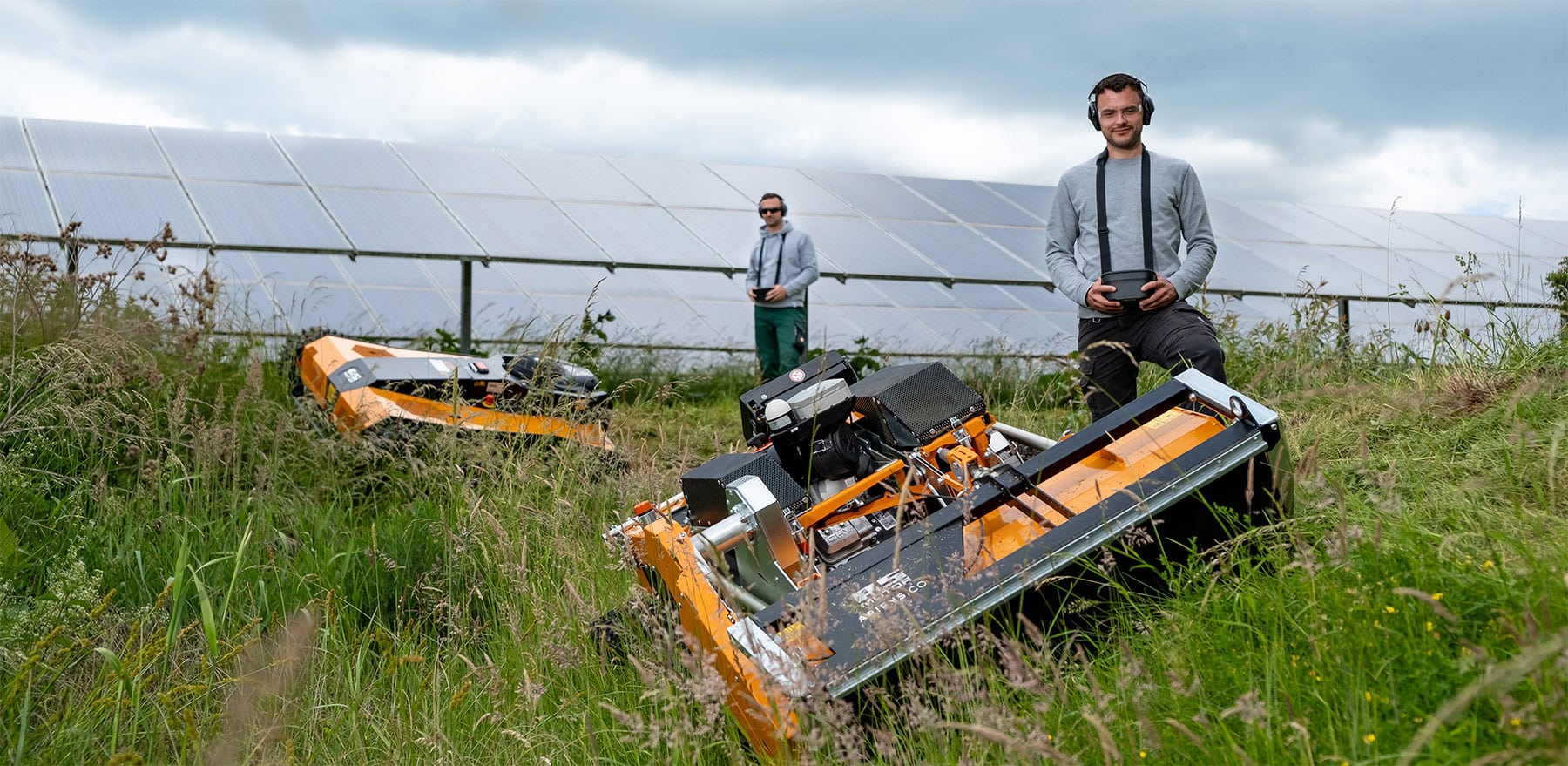
Solar parks can support biodiversity
Solar parks are not purely technical sites. With the right maintenance concept, they can become valuable habitats for plants, insects, birds, reptiles and small mammals. The nationwide bne field study Biodiversity in Solar Parks examined 30 photovoltaic ground-mounted systems in Germany in 2024 and systematically evaluated eight species groups. The central finding: solar parks on agricultural land can increase biodiversity in cultivated landscapes.
Fraunhofer ISE also treats this interface between energy generation and nature conservation as a dedicated research field. Under the term Biodiversity Photovoltaics, the institute researches how biodiversity on photovoltaic areas can be increased without causing losses in electricity yield.
The conclusion for operators is clear: solar park maintenance must combine technical function and ecological development. Cutting everything short sacrifices biodiversity. Neglecting maintenance risks woody encroachment, shading and restricted access.
How often should a solar park be mowed?
Many solar parks are mowed two to three times per year. In practice, this interval makes sense because it keeps the area open, preserves access to the technical infrastructure and limits disturbance to the vegetation.
The exact maintenance schedule depends on the site. Nutrient-rich soils produce stronger growth and may require more intensive maintenance at the beginning. Nutrient-poor areas can often remain stable with fewer interventions. Nature conservation requirements, vegetation type, slopes, soil conditions and the construction height of the solar modules also influence maintenance needs.
AS-Motor follows the principle of ecological mowing: as little intervention as possible, as much maintenance as necessary. No maintenance is not a solution, because open, species-rich structures can be lost through woody encroachment. At the same time, mowing the entire site too often weakens biodiversity.
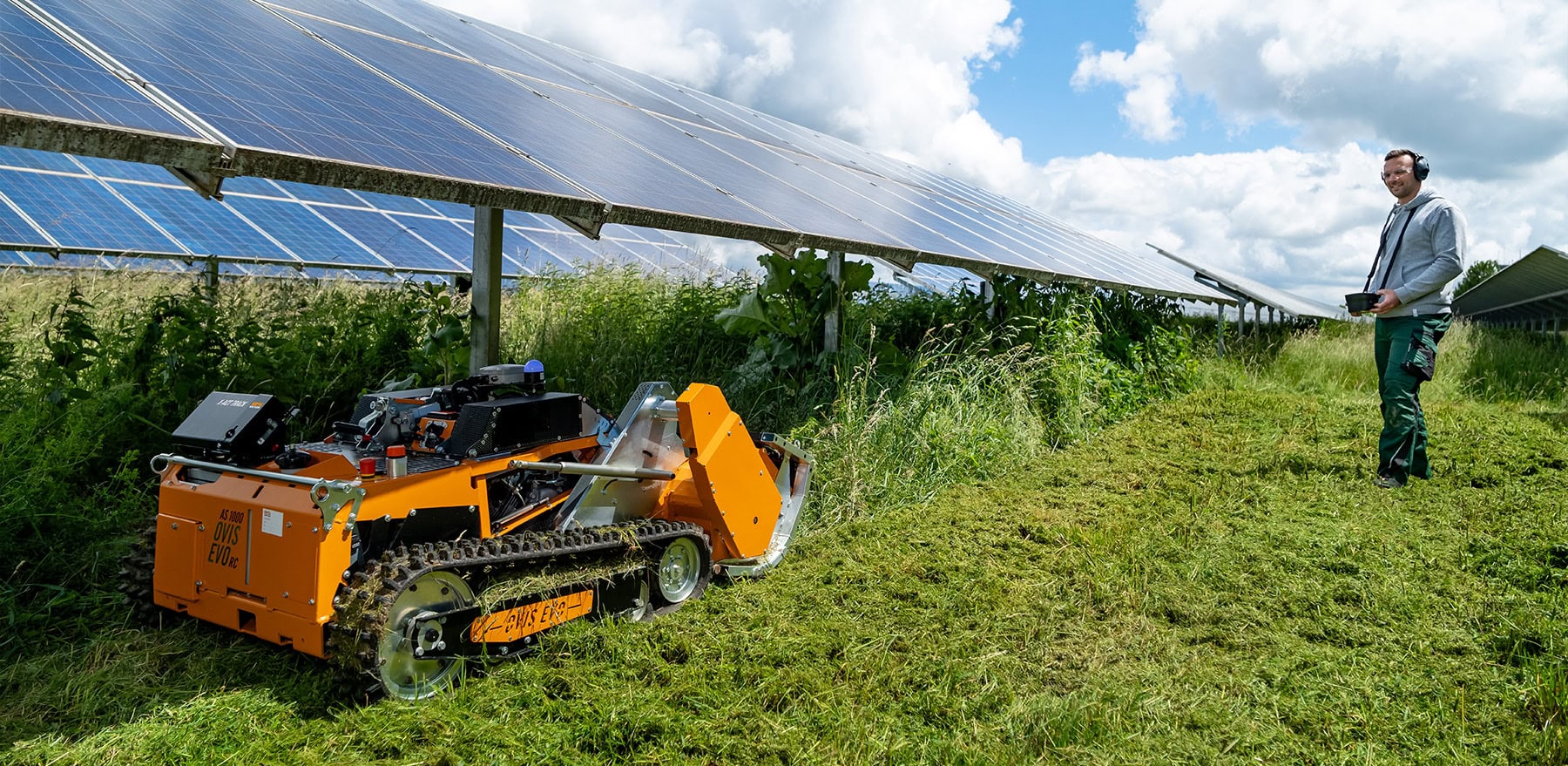
Mowing under solar panels: the critical zone
The most difficult maintenance areas are directly below the lower edge of the solar panels. This is where many machines leave uncut strips because their height, width or manoeuvrability does not match the system geometry. The result is follow-up work with brushcutters or hand tools, higher labour input and an inconsistent maintenance result.
AS-Motor machines are highly relevant for these confined areas. The AS 1000 Ovis RC and AS 1000 Ovis EVO RC measure 184 x 115 x 69 cm. The AS 990 Tahr RC measures 152 x 131 x 72 to 80 cm. Depending on the photovoltaic system design, these machines can partially drive under the lower module edge and mow where larger machines have to stop.
The benefit is concrete: fewer uncut grass strips, less manual follow-up work, better accessibility and a consistently maintained surface. At the same time, the efficiency of the solar system is protected because high vegetation does not cover the lower part of the panels.
Ecological mowing: do not cut everything at once
Biodiversity-friendly solar park maintenance needs structure. The most important rule: do not mow the entire area completely in a single operation. If all areas are cut short at the same time, food sources, cover and retreat zones disappear at once.
AS-Motor recommends ecological mowing practices such as sectional mowing, escape routes, old grass strips and rotating unmown areas. Depending on the maintenance objective, 10 to 20 percent of the area should remain unmown. This allows subpopulations to survive and later recolonise mown areas.
Mowing direction also matters. Mowing from the centre outwards or in strips helps animals escape from the area. For large fenced solar parks, this is particularly relevant because animals and insects often have limited escape options.
Insect scare device: a practical advantage for biodiversity-oriented maintenance
Solar parks with extensive vegetation management attract insects. That is the goal. This is exactly why mowing technology must respond to it.
The insect scare device from AS-Motor scares flying insects away before the mower reaches the area. This gives insects more time to leave the danger zone. Beetles and caterpillars can also be brushed off and fall to the ground outside the cutting area.
In a field trial by the University of Hohenheim with an AS 63 high grass mower, almost three times as many insects were flushed out in front of the mower with the insect scare device as without the insect scare device. For solar park operators, this is a solid technical advantage: maintenance remains efficient while becoming more compatible with biodiversity goals, species protection requirements and nature-oriented land management.
Mulching or removing cuttings?
Whether cuttings should remain in the solar park or be removed depends on the maintenance objective. Mulching is efficient, reduces the work required per maintenance pass and is suitable for many operational zones. The shredded material remains on the surface and can decompose.
If biodiversity, nutrient reduction and species richness are the main objectives, removing the cuttings can make sense. The German Federal Agency for Nature Conservation explains in its information on solar parks and biodiversity that removing mown material is important for nutrient reduction, especially on areas not covered by modules. On nutrient-poor sites, a higher diversity of plants can often develop, which in turn benefits insects and birds.
The strongest approach is zoned maintenance: mulching in areas where efficiency and operational safety are the priority, removal of cuttings in ecologically prioritised zones.
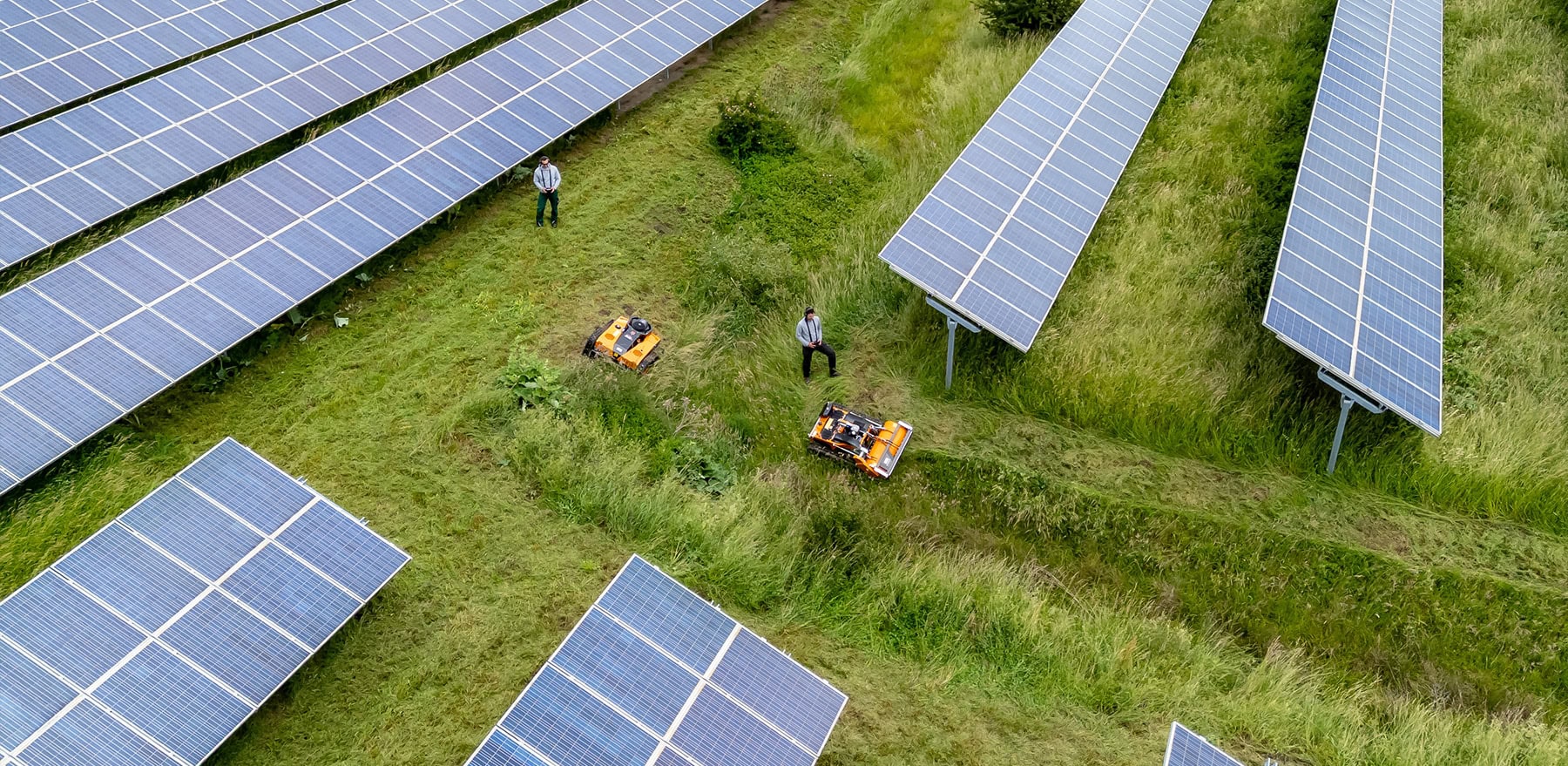
The AS-Motor zone model for solar parks
Every solar park consists of different maintenance zones. Treating all zones the same costs efficiency. AS-Motor therefore recommends looking at the area according to its specific use zones.
Under the modules
Low overall height, precise control and controlled mowing close to posts, cables and support structures matter here. The AS 1000 Ovis RC and AS 1000 Ovis EVO RC are particularly suitable thanks to their 69 cm overall height. With a height of 72 to 80 cm, the AS 990 Tahr RC can also work under obstacles depending on the system geometry.
Between the module rows
Between the rows, clean lanes, an even mowing result and high area performance are decisive. In large systems, the AS 1000 Ovis EVO RC with X-ACT TRACK supports precise lane guidance and reduces overlap.
Margins and fence lines
Dense wild growth often develops along fences, paths and margins. These areas must remain accessible for inspection, maintenance and safety. Robust mowing systems are needed to handle high grass and irregular vegetation reliably.
Embankments and difficult terrain
Many solar parks are located on conversion sites, marginal land, slopes or uneven terrain. Remote-controlled tracked mowers increase occupational safety because the operator does not stand directly in the danger zone. At the same time, they provide strong traction and stability.
Biodiversity and compensation areas
These areas should be maintained according to ecological objectives. Sectional mowing, later mowing dates, retreat zones and, where appropriate, removal of cuttings are the priority here.
Flail or rotary mowing: which cutting system fits solar parks?
Both flail mowers and rotary mowers can be useful in solar park maintenance. The decision depends less on the solar park as a category and more on vegetation type, desired finish and maintenance objective.
Flail mowers such as the AS 1000 Ovis RC and AS 1000 Ovis EVO RC are strong in extensive maintenance, high grass, dense vegetation and irregular growth. They shred the material intensively and are particularly suitable for areas that are only mowed a few times per year.
Rotary mowers such as the AS 990 Tahr RC are powerful, efficient and produce an even cutting result. They are suitable for solar parks with larger areas, wider maintenance zones, margins, embankments and vegetation that needs to be mowed quickly and distributed broadly.
For many solar parks, both systems are suitable. The decisive factor is matching the mowing system to vegetation, maintenance interval, terrain structure and desired result.
AS 1000 Ovis RC and AS 1000 Ovis EVO RC: compact machines for narrow module areas
The AS 1000 Ovis RC and AS 1000 Ovis EVO RC are compact remote-controlled flail mowers for hard-to-access areas, high grass and demanding terrain. With an overall height of 69 cm, the AS 1000 Ovis RC and AS 1000 Ovis EVO RC can, depending on module construction, work close to low areas under solar panels.
The flail mower system is an advantage in extensive maintenance intervals, dense vegetation and irregular growth. For solar parks, this means reliable cutting performance in wild growth, less manual follow-up work and precise maintenance in areas that are difficult for larger machines.
The AS 1000 Ovis EVO RC can also be used with X-ACT TRACK. X-ACT TRACK supports more consistent lane guidance on large, structured areas and helps reduce overlaps and uncut strips.
AS 990 Tahr RC: powerful for embankments, margins and area performance
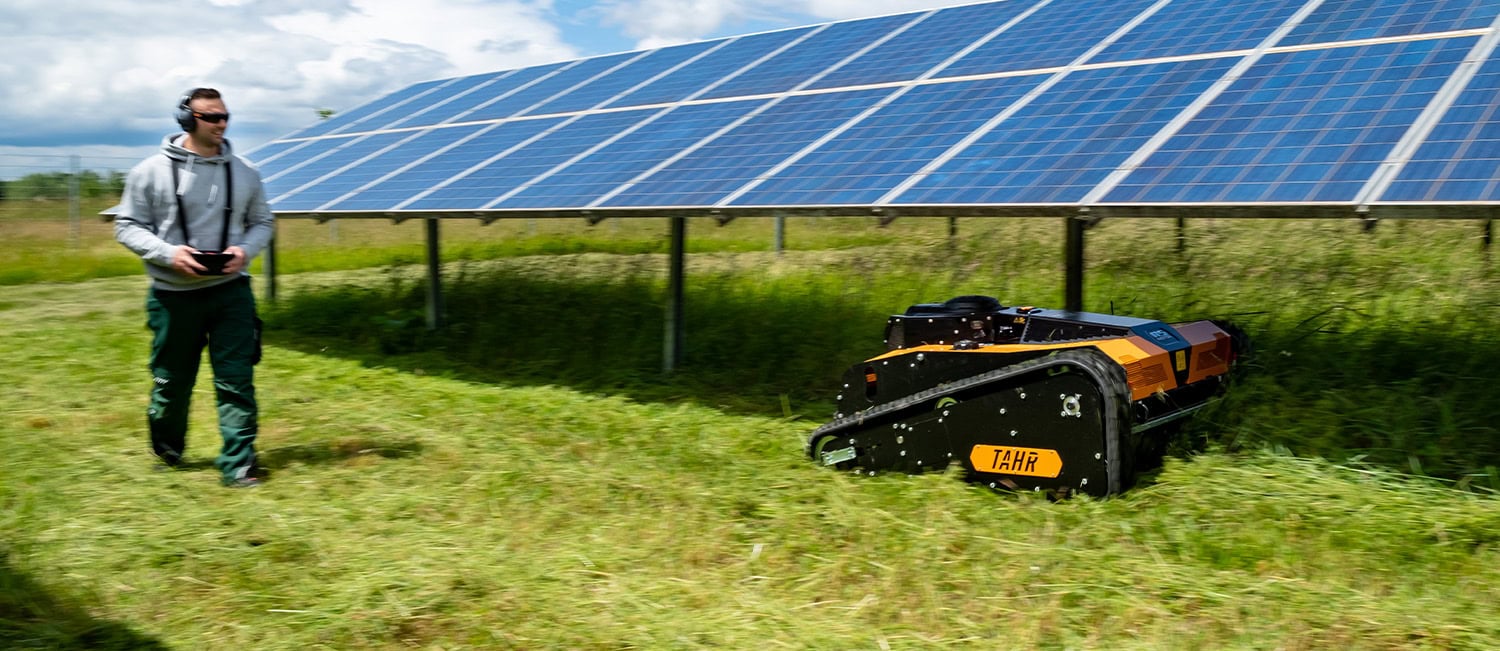
The AS 990 Tahr RC is a remote-controlled rotary mower with tracked drive for high vegetation, steep slopes and hard-to-access areas. The AS 990 Tahr RC mows forward and backward without requiring a turn at the end of every lane. This saves time, reduces manoeuvring and protects soil and turf.
With dimensions of 152 x 131 x 72 to 80 cm, slope suitability up to 50°, remote-control range up to 300 m and maximum area performance of 4,500 m²/h, the AS 990 Tahr RC is particularly strong in margins, embankments, fence lines, service paths and large maintenance zones.
For solar parks, the AS 990 Tahr RC is especially relevant when high area performance, robust rotary mowing technology and safe operation from a distance are required.
Advantages of AS-Motor for solar park maintenance
AS-Motor machines combine compact dimensions, robust mowing technology and safe remote-controlled operation. This is decisive for solar parks because the maintenance area is more complex than a normal meadow.
The key advantages:
- low overall height for mowing under solar panels
- remote-controlled operation for greater safety on slopes and hard-to-access areas
- tracked drive for traction on uneven, wet or difficult ground
- powerful mowing systems for high grass, wild growth and extensive maintenance intervals
- less follow-up work along module rows, fence lines and margins
- technical support for biodiversity-oriented mowing through the insect scare device
- high area performance for professional contractors and solar park operators
- suitable mowing technology for different maintenance objectives: flail mowing with the AS 1000 Ovis RC and AS 1000 Ovis EVO RC, rotary mowing with the AS 990 Tahr RC
Frequently asked questions about solar park maintenance
Many solar parks are mowed two to three times per year. The right interval depends on the site: nutrient-rich soils, fast woody growth or dense vegetation can require more frequent maintenance, while nutrient-poor sites can often be managed extensively. The key is a maintenance plan that combines operational safety, module accessibility and biodiversity. The German Federal Agency for Nature Conservation explains in the context of solar parks and biodiversity that nutrient-poor areas can often develop higher plant diversity and that maintenance should therefore be planned according to site conditions.
Vegetation management in solar parks secures access to modules, inverters, cable routes, fence lines and service paths. High vegetation can make technical infrastructure harder to reach and, depending on the system layout, shade the lower section of the solar panels. Vegetation management is also a relevant cost factor in operations. JUWI describes green maintenance in solar parks as part of economic operations management, directly connected to efficiency, biodiversity and operational safety.
Yes, if they are planned and maintained according to site conditions and managed extensively. The nationwide bne field study Biodiversity in Solar Parks examined 30 photovoltaic ground-mounted systems in Germany in 2024 and evaluated eight species groups. The key finding: solar parks on agricultural land can increase biodiversity in cultivated landscapes.
Extensively maintained solar parks can create habitats for flowering plants, wild bees, grasshoppers, butterflies, birds, reptiles and small mammals. The bne study on biodiversity in modern solar parks shows that photovoltaic ground-mounted systems can be relevant habitats for different species groups when the areas are not managed intensively.
No. Mowing the entire area in one operation is ecologically weak because food sources, cover and retreat zones disappear at the same time. Sectional maintenance with rotating old grass strips and unmown retreat areas is the better approach. In its own guidance on ecological mowing, AS-Motor recommends leaving 10 to 20 percent of an area unmown depending on the objective and maintaining areas in sections.
Both can be correct. Mulching is efficient and suits operational zones where fast maintenance, good accessibility and minimal follow-up work are the priority. Removing cuttings is useful when nutrient reduction and plant diversity are the objective. The German Federal Agency for Nature Conservation describes the removal of mown material for nutrient reduction as an important factor, especially on areas not covered by modules.
Solar parks require compact, terrain-capable and remote-controlled mowers that can work under solar panels, between module rows, along fence lines and on embankments. AS-Motor uses remote-controlled tracked mowers such as the AS 1000 Ovis RC, AS 1000 Ovis EVO RC and AS 990 Tahr RC for these applications.
Depending on the photovoltaic system design, AS-Motor mowers can partially drive directly under the lower edge of solar panels and mow there. The AS 1000 Ovis RC and AS 1000 Ovis EVO RC measure 184 x 115 x 69 cm. The AS 990 Tahr RC measures 152 x 131 x 72 to 80 cm. This low overall height is an operational advantage because fewer grass strips remain under the modules and less follow-up trimming with brushcutters or hand tools is required.
The lower module edges of many photovoltaic ground-mounted systems limit machine height. If a mower cannot reach far enough under the panels, grass and wild growth remain directly at the module edge. This increases follow-up work, can shade the lower part of the panels and makes a consistent maintenance result harder to achieve. Compact machines such as the AS 1000 Ovis RC, AS 1000 Ovis EVO RC and AS 990 Tahr RC reduce this problem because, depending on the system geometry, they can work closer to the critical areas.
Both systems can be suitable in solar parks. Flail mowers such as the AS 1000 Ovis RC and AS 1000 Ovis EVO RC are strong in high grass, dense vegetation and extensive maintenance intervals. Rotary mowers such as the AS 990 Tahr RC work efficiently, create an even cutting pattern and are suitable for larger maintenance zones, margins and embankments. The right choice depends less on the solar park as a category and more on vegetation, maintenance objective, terrain structure and desired result.
Insects cannot be fully protected during mowing, but the impact can be reduced. Later mowing dates, sectional mowing, unmown retreat strips, higher cutting heights and technical aids such as the insect scare device are useful. In its guidance on ecological mowing, AS-Motor refers to a field trial by the University of Hohenheim with an AS 63 high grass mower: with the insect scare device, almost three times as many insects were flushed out in front of the mower as without the insect scare device.
Remote-controlled mowers keep the operator out of the direct danger zone. This is especially relevant on embankments, uneven ground, fence lines, wet vegetation and hard-to-access module areas. For the AS 990 Tahr RC, AS-Motor specifies a professional remote control with LCD display for blade status, cutting height, incline and battery level, as well as a range of up to 300 m.
X-ACT TRACK supports precise lane guidance for recurring mowing passes. This is relevant for large solar parks because long module rows require high concentration and imprecise lanes lead to overlap or uncut strips. From the operator’s perspective, the work shifts from constant steering toward monitoring, supporting consistent work quality over longer operating periods. X-ACT TRACK is therefore especially relevant for structured areas with recurring mowing lanes.
The best approach is zoned maintenance. Technical operating areas such as service paths, inverter zones, fence lines and lower module edges are maintained functionally. Biodiversity areas are managed more extensively, with sectional mowing, retreat strips and adapted mowing dates. Fraunhofer ISE researches under the term Biodiversity Photovoltaics how biodiversity on photovoltaic sites can be increased without reducing electricity yield.
The biggest mistake is using one uniform strategy for the entire site. A solar park consists of different zones: under the modules, between rows, along fence lines, on embankments, on service paths and on ecological compensation areas. Each zone has different requirements. Mowing everything equally short at the same time reduces ecological quality. Maintaining too little risks woody encroachment, shading and restricted access. The solution is a maintenance concept with suitable machines, defined intervals and clear zoning.
Conclusion: mowing solar parks efficiently and ecologically
Solar park maintenance connects operations management, area performance, occupational safety and ecology. Cutting everything short sacrifices biodiversity. Maintaining too little risks shading, woody encroachment and restricted access. The professional approach sits between these extremes: extensive maintenance with the right technology.
AS-Motor offers specialised solutions for this work. The AS 1000 Ovis RC and AS 1000 Ovis EVO RC work compactly and precisely in narrow module areas. The AS 990 Tahr RC delivers high area performance on embankments, margins and difficult vegetation. X-ACT TRACK supports efficient lane guidance in large systems. The insect scare device adds an important technical component for ecological mowing.
This turns solar park maintenance into a controlled process: less follow-up work, better accessibility, higher operational safety and more space for biodiversity.
Categories
Professional technology
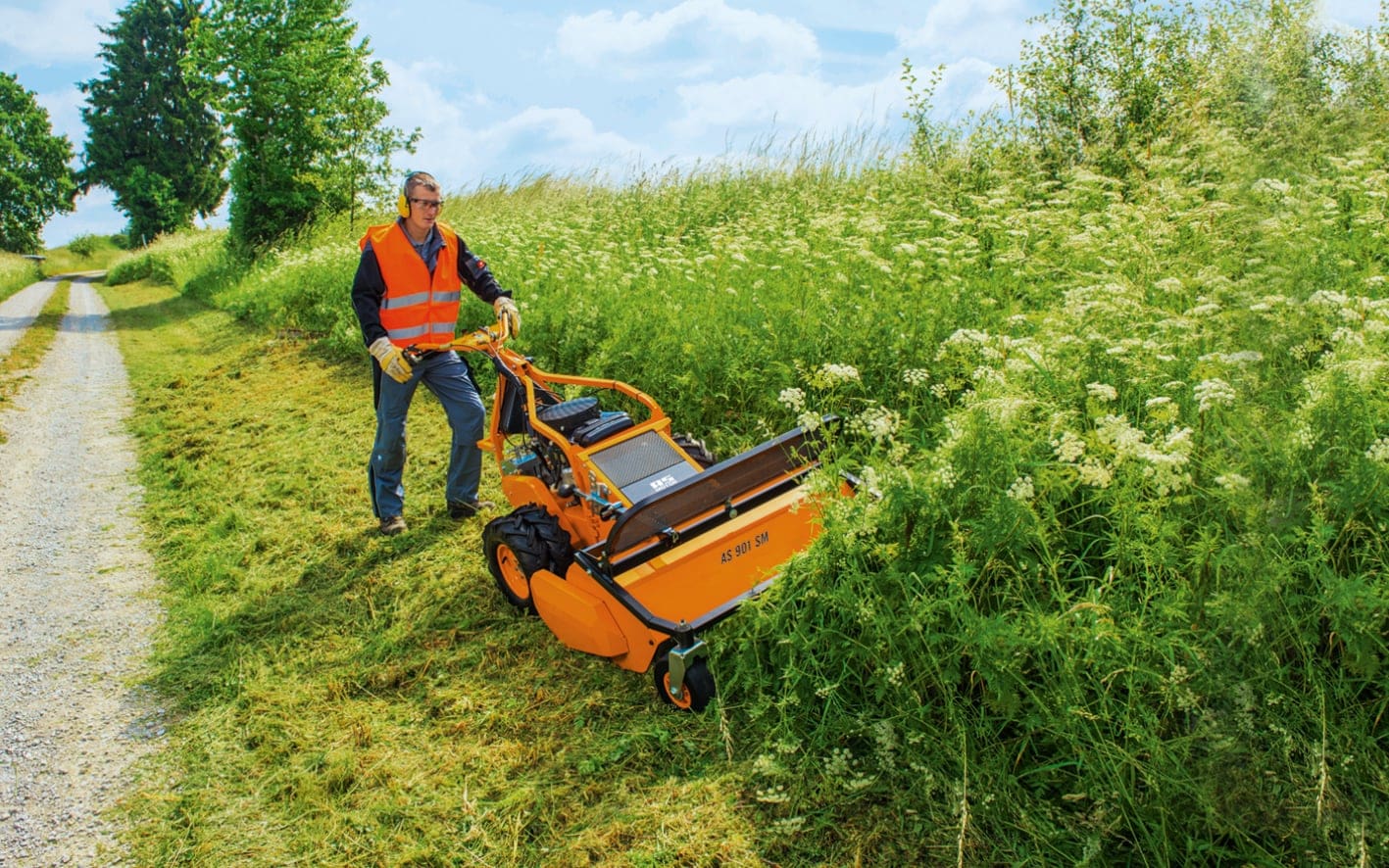
During the mowing season, professional operators often run their machines 5 days per week, 8 hours per day. AS-Motor’s machines are unbeatable in terms of quality, durability and professional work results. Additional advantages include low weight, lashing points and compact transport dimensions.
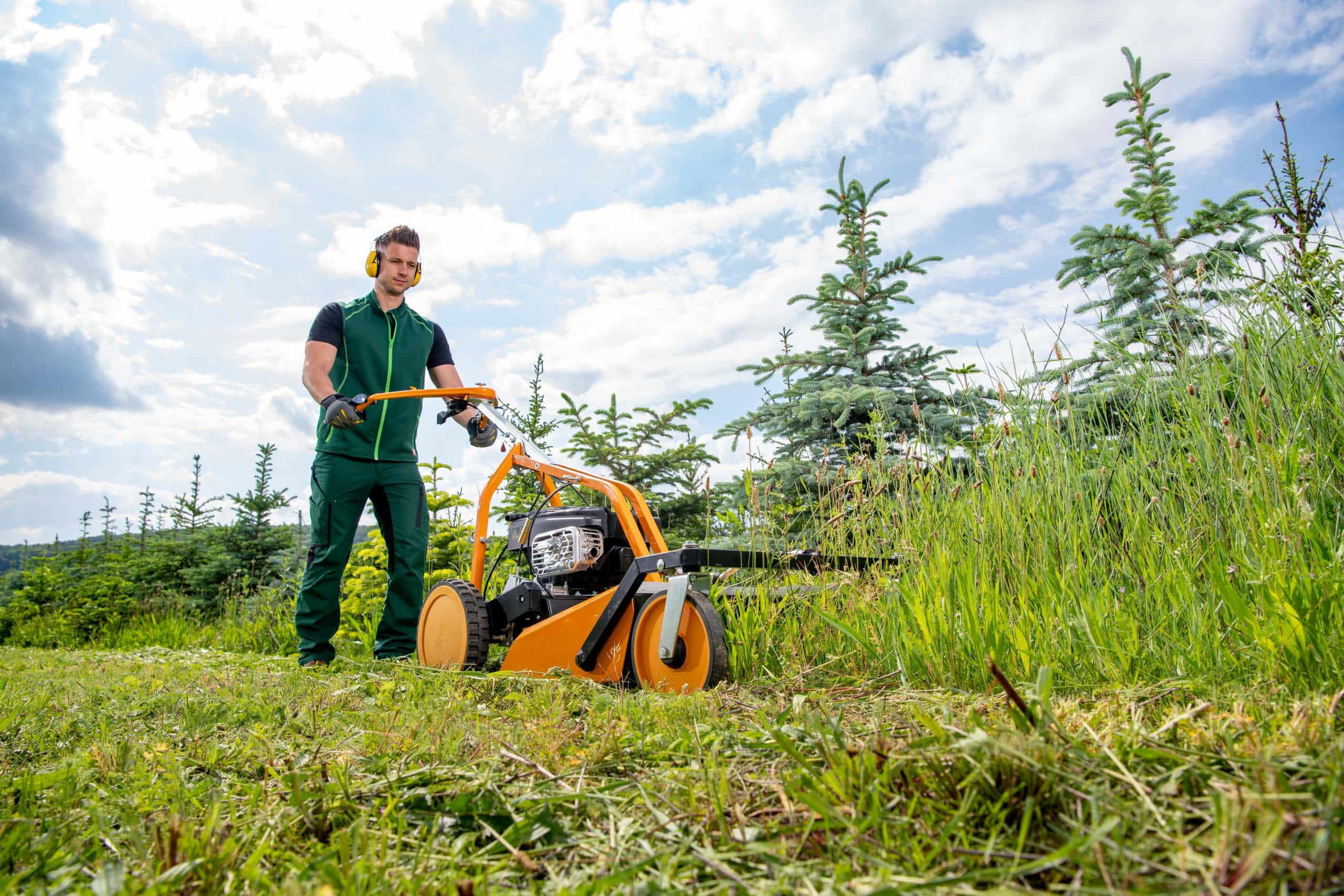
High meadow grass
Extensively used meadows such as orchards, compensation areas, or roadside greenery are deliberately mowed only once or twice a year. The vegetation reaches heights of 60 to over 100 cm and forms dense, structurally rich stands.
This form of maintenance serves to keep the area open and suppress woody plants, not to maintain the lawn. Machines with high throughput, uniform cutting performance, and controlled deposition of the cut material are required. This is the only way to efficiently manage large amounts of biomass without overloading the area or damaging the soil and vegetation.
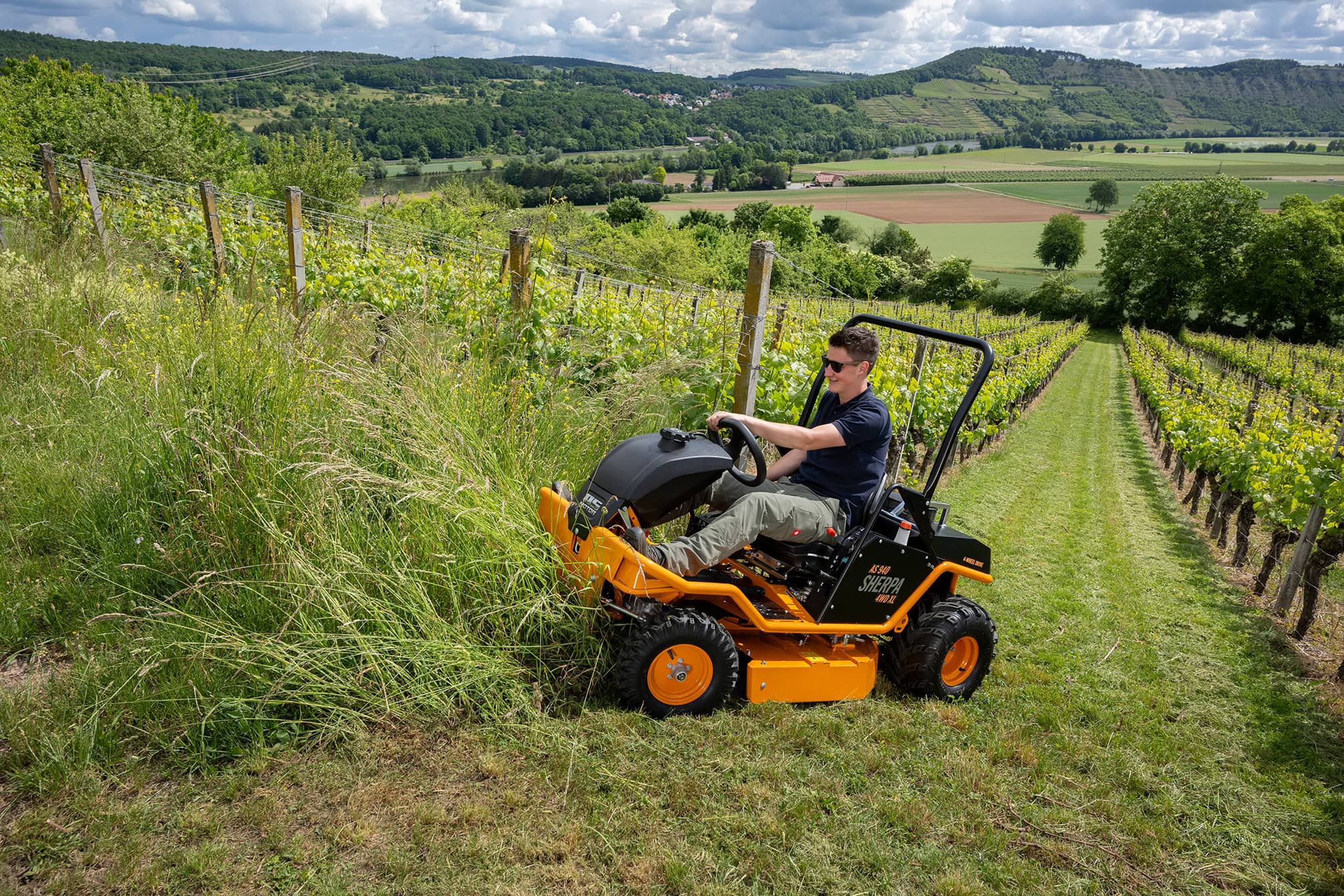
Uneven terrain
Animal burrows, anthills, mole hills and water channels cause uneven terrain. Several AS-Motor machines have high ground clearance, all-wheel drive and limited slip differential, along with appropriately studded field tyres, for uneven terrain.
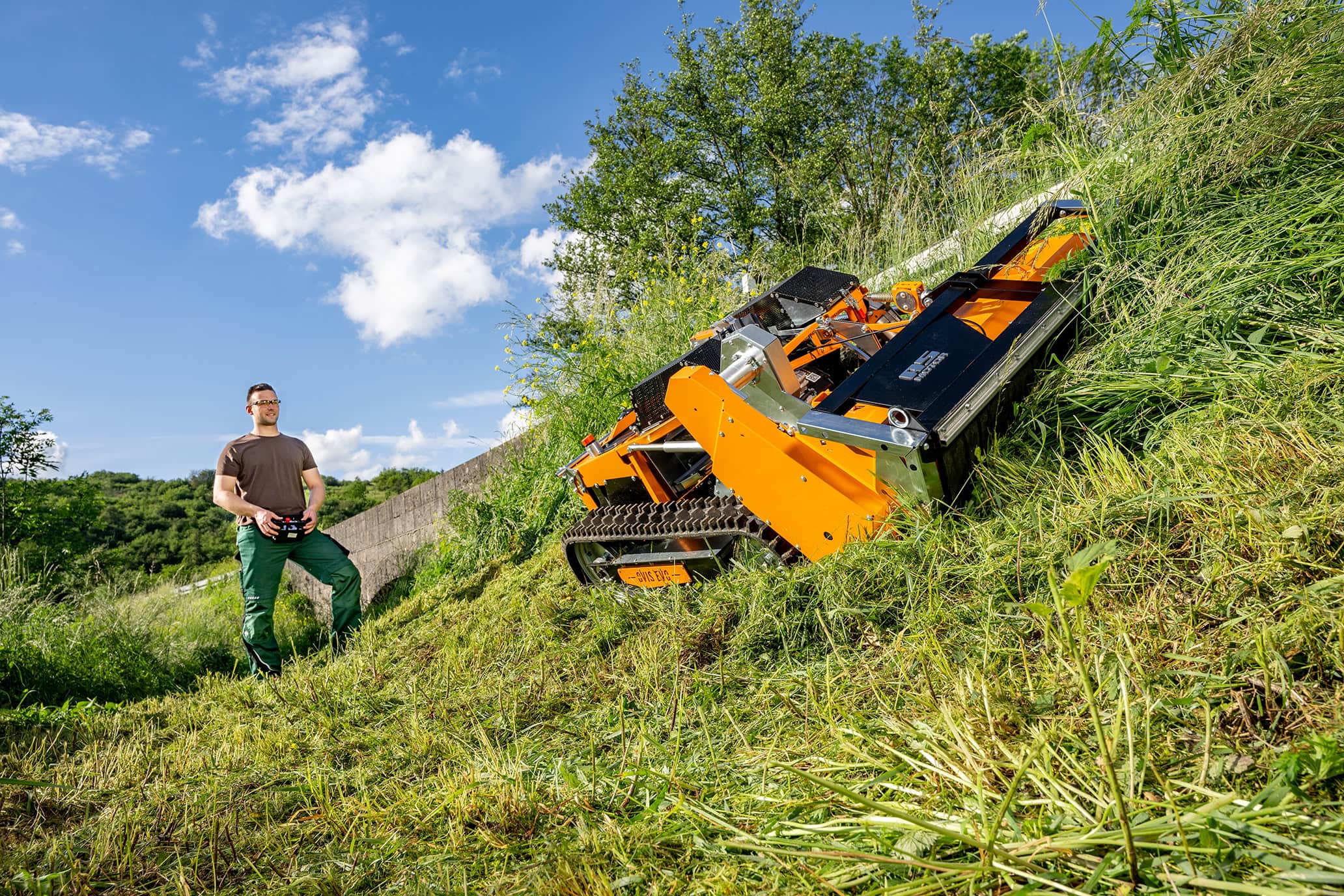
Slopes
AS-Motor engineers machines with high ground clearance, steep ramp angles, low overall weight, optimal weight distribution and a low centre of gravity to perform on slopes.
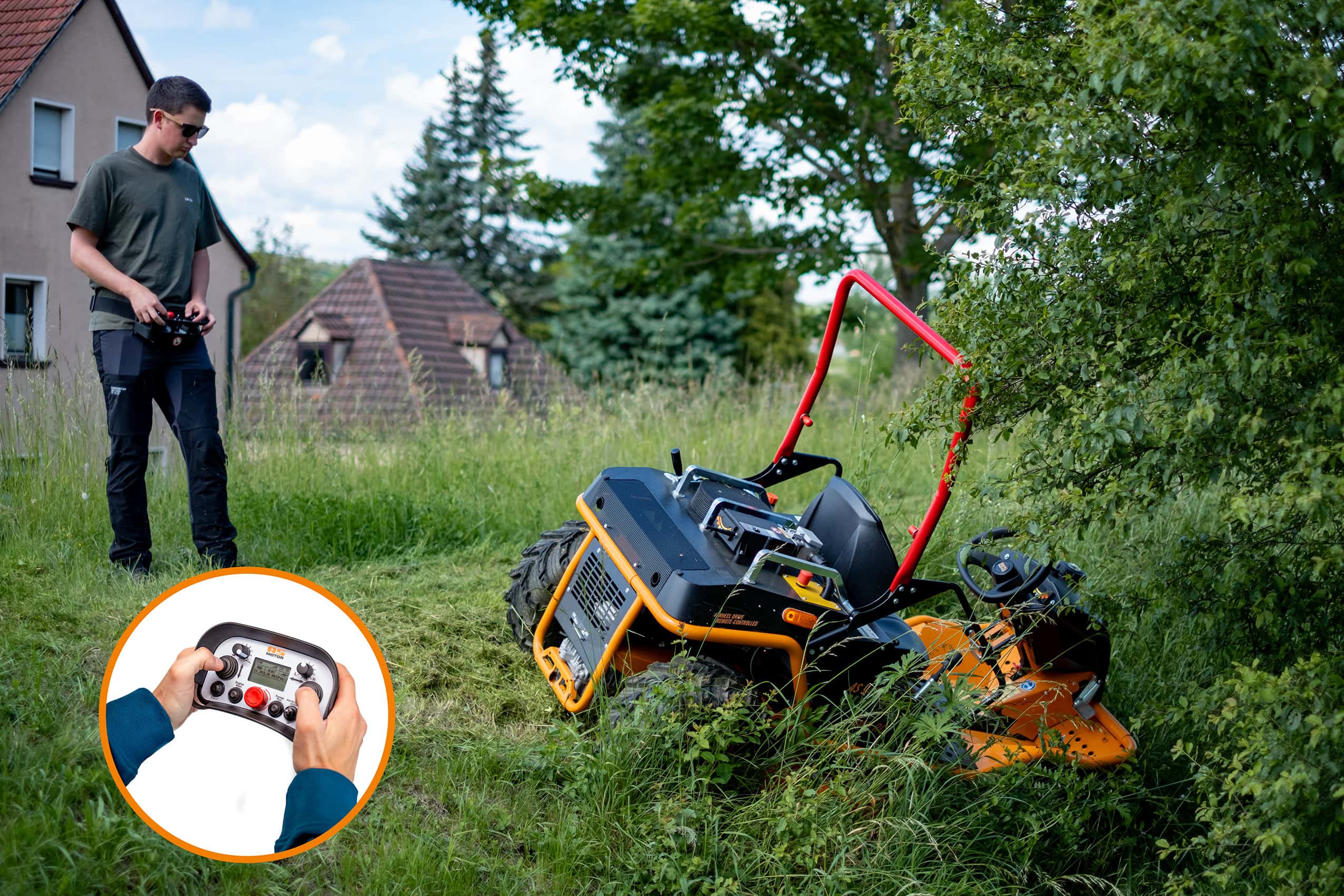
Remote-controlled Mowers
Remote controlled devices make the mowing of extreme slopes possible. This technology also allows the operator to mow at a safe distance from dust, wasps, ticks and other hazards.
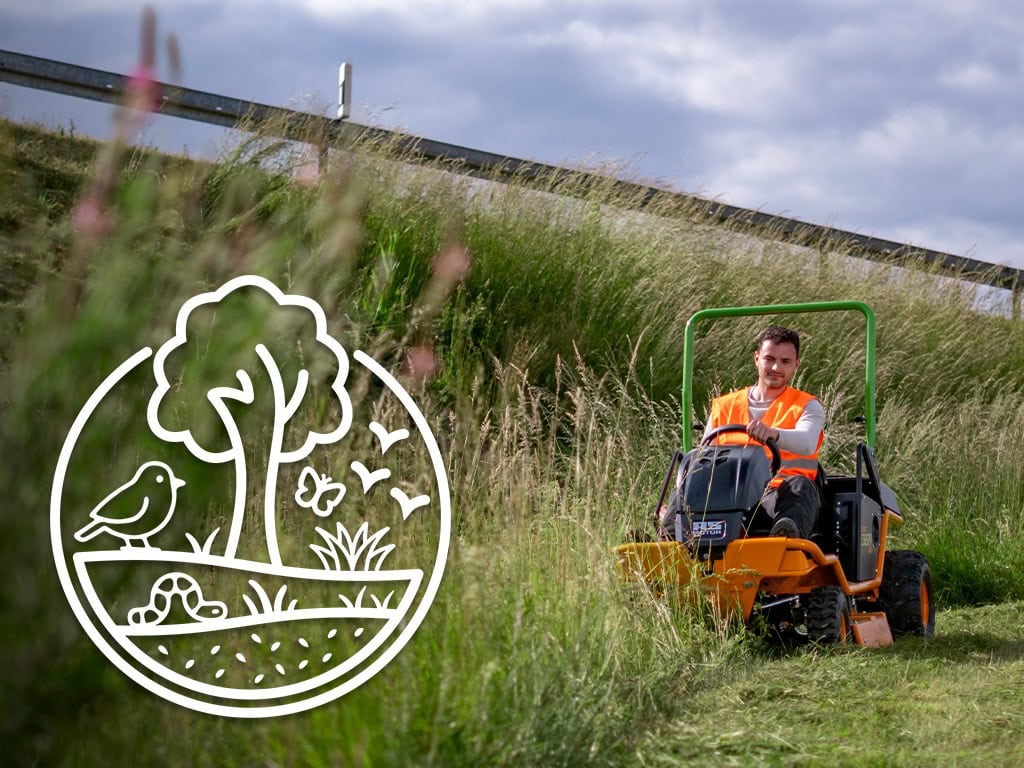
Ecological mowing & extensive land management
Ecological mowing and extensive land management focus on reduced, targeted interventions instead of blanket mowing. Cutting heights, timing, and maintenance intervals are based on vegetation development and site conditions, not on maximum area coverage.
Sub-areas are mowed on a rotating basis, while others are deliberately left untouched. This creates varying growth heights, refuges, and stable structures on extensive meadows, compensation areas, municipal green spaces, and in landscape management. Technology is used for control, not intensification.