Safely mowing steep slopes: Why Braunfels chose a remote-controlled mowing crawler
Steep embankments are part of the daily work routine for the municipality of Braunfels’ municipal works department. This is especially true around the castle, where challenging terrain, seasonal overgrowth and high safety requirements all come together. When the city searched for a new mowing solution in 2026, it already had a very clear idea of what the machine needed to do. The background to this decision dates back around four years.
Anyone familiar with Braunfels will also know the city’s topography. The castle stands prominently above the town, with slopes and green spaces stretching across the landscape. While this defines the city’s appearance, it also presents regular challenges for the works department during the mowing season: embankments need to be maintained, hard-to-access areas must be kept clear, and roadside greenery requires attention, even though some areas are difficult to reach with conventional mowing equipment.
For works department manager Steffen Portz and his team, the priority is not just cutting grass as quickly as possible. On slopes, the key question is how safely an area can be maintained and how much working time is lost to manoeuvring, turning or time-consuming machine changes.
One embankment near the castle had long been a known issue in this regard. It had already played a role in a machine demonstration that took place around four years before the city later acquired the new AS 990 Tahr RC.
The first demonstration revealed where time was being lost in the workflow
AriensCo EMEAA field service representative Nico Thiel was still new to his sales territory when he brought a remote-controlled AS-Motor machine to Braunfels. On the steep slope near the castle, the demonstration was set to show how the terrain could be managed with an RC solution.
The basic principle matched the works department’s requirements. Since the operator controls the machine remotely, they do not have to sit on a ride-on mower on the slope themselves. This is a crucial difference, especially on difficult embankments, as the operator’s position can be chosen independently of the machine’s location.
However, the demonstration also made it clear that slope capability alone was only part of the challenge. After each mowing pass, the machine used at the time had to turn before the next pass could begin. On a long, drawn-out embankment, this process repeats many times, resulting in lost working time spent on manoeuvres rather than mowing.
At this point, the demonstration remained just that. Yet the requirements for the area did not change. The works department still had to maintain the embankments, while high overgrowth and limited staffing resources during the season put additional pressure on the available working time.
When the topic was revisited a few years later, the city was therefore able to specify very clearly what a new solution needed to improve.
The search was for a mowing crawler that could work on slopes without constant turning
The new initiative came from AS-Motor specialist dealer Weimer from Lollar, who took up the requirements together with the works department and AS-Motor. This time, the focus was not on the general question of whether a remote-controlled mowing crawler might be of interest to Braunfels. The experience from the first demonstration had already shown which features were relevant for the existing areas.
The new machine had to handle demanding slopes while also enabling a workflow that minimised time lost to turning manoeuvres. For the city, another key factor was improving the safety of works department employees when working on steep embankments.
This led to a clear technical requirement: The machine had to be able to mow both forwards and backwards.
This brought the AS 990 Tahr RC into focus. Its rotary mower deck works in both directions of travel. Once the operator has completed a pass, they can change direction and work back along the next pass without having to turn the entire mowing crawler 180 degrees first.
On a small, flat green space, this difference would barely matter. On a longer embankment, where the same process repeats pass after pass, it significantly changes the way work is carried out.
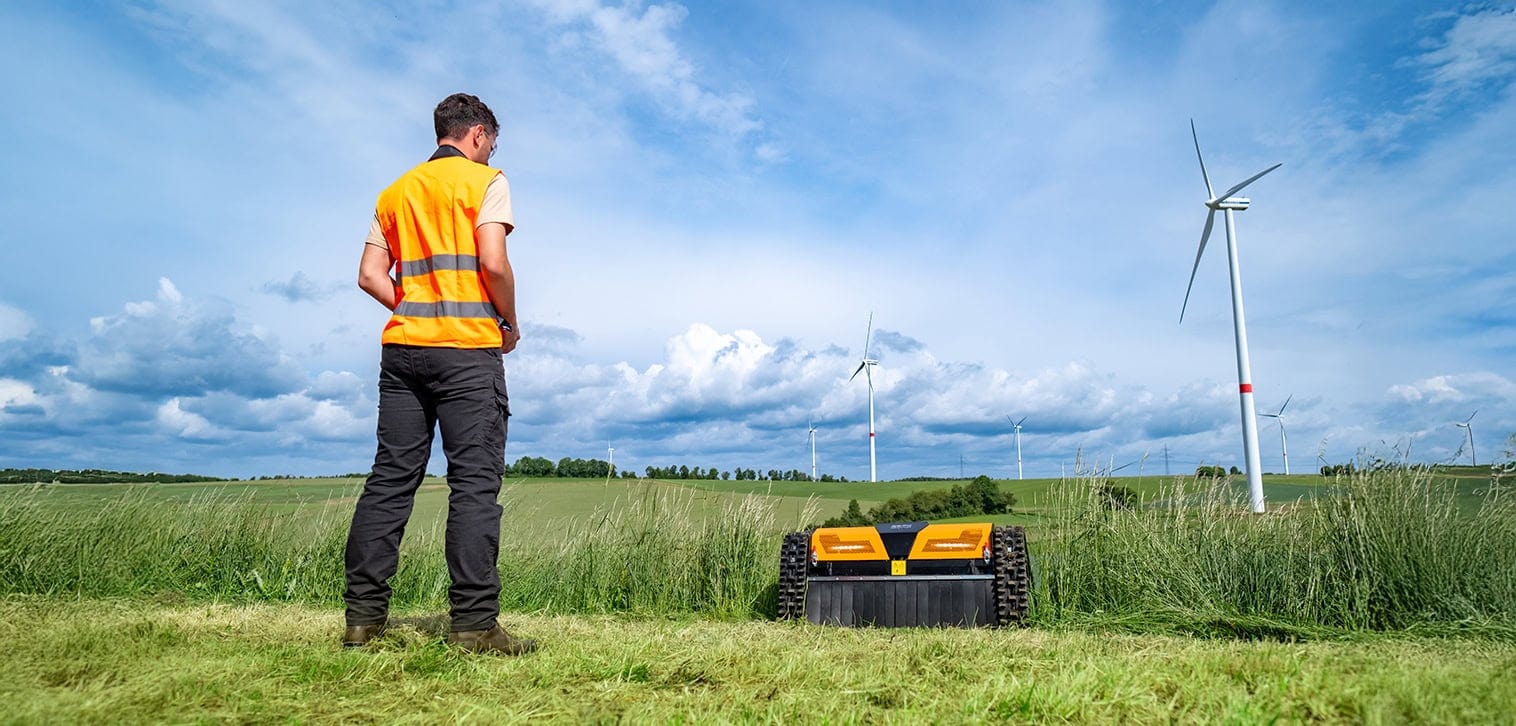
During the demonstration, the machine had to handle the real problem area
Whether this solution was truly suitable for Braunfels was not to be decided on a flat demonstration area. Weimer and AS-Motor therefore brought the AS 990 Tahr RC to the very place where its suitability would have to prove itself in later use: the embankment near the castle.
For the works department, this approach had a clear advantage. Slope gradient, soil conditions, overgrowth and the shape of the area did not need to be assessed theoretically; instead, they could be directly factored into the decision. At the same time, it was possible to observe how the bidirectional mowing concept performed under actual conditions.
Nico Thiel particularly remembers how the works department team reacted to the machine’s slope capability:
Nico Thiel particularly remembers how the works department team reacted to the machine’s slope capability:
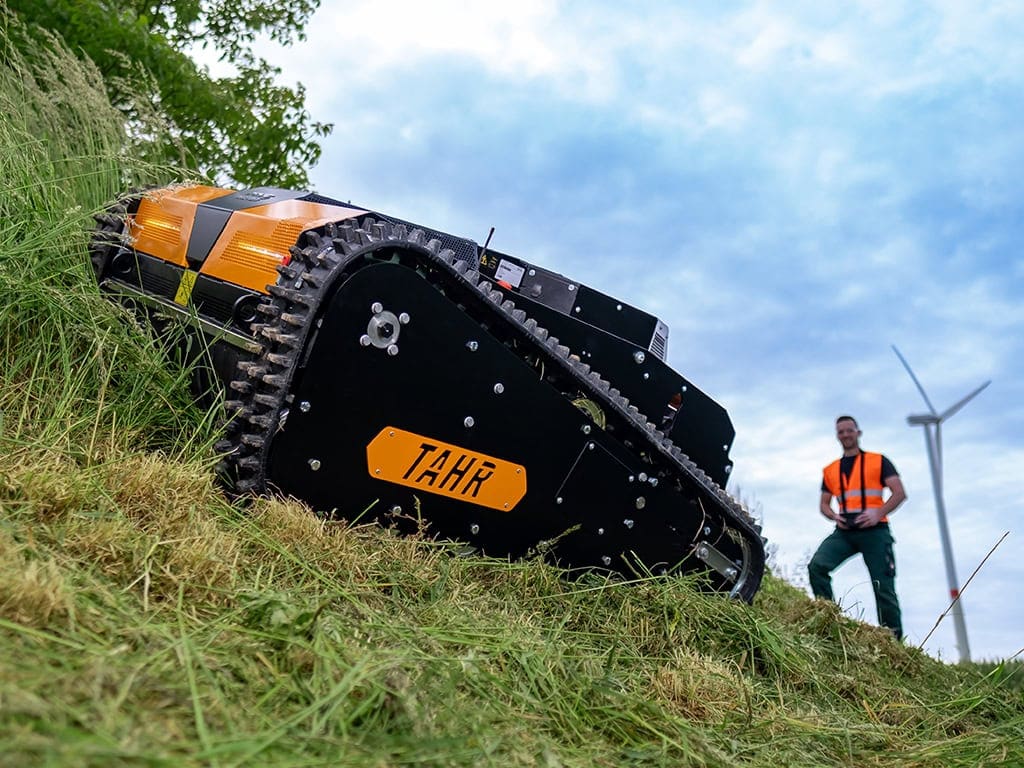
The requirements were very clear during the second demonstration. The machine had to handle the steep slope and be able to mow both forwards and backwards. We drove up inclines where the colleagues from the works department were themselves surprised that the Tahr could manage it. At the same time, after each mowing pass, we could immediately continue working in the opposite direction without having to turn the entire machine every time. It was precisely this combination that convinced them on the site.
The ability to mow in both directions addressed an issue that had already been identified during the first demonstration. What had previously required additional turning manoeuvres in the workflow could now be resolved differently with the Tahr RC.
Workplace safety was the decisive factor for the city
While a more efficient workflow is relevant for a municipal works department, the city of Braunfels justified its investment primarily on the grounds of employee safety. Steep slopes, embankments and difficult-to-access green spaces present different challenges to well-maintained, flat lawns; the more demanding the terrain, the more important it becomes to consider where the operator is positioned during work.
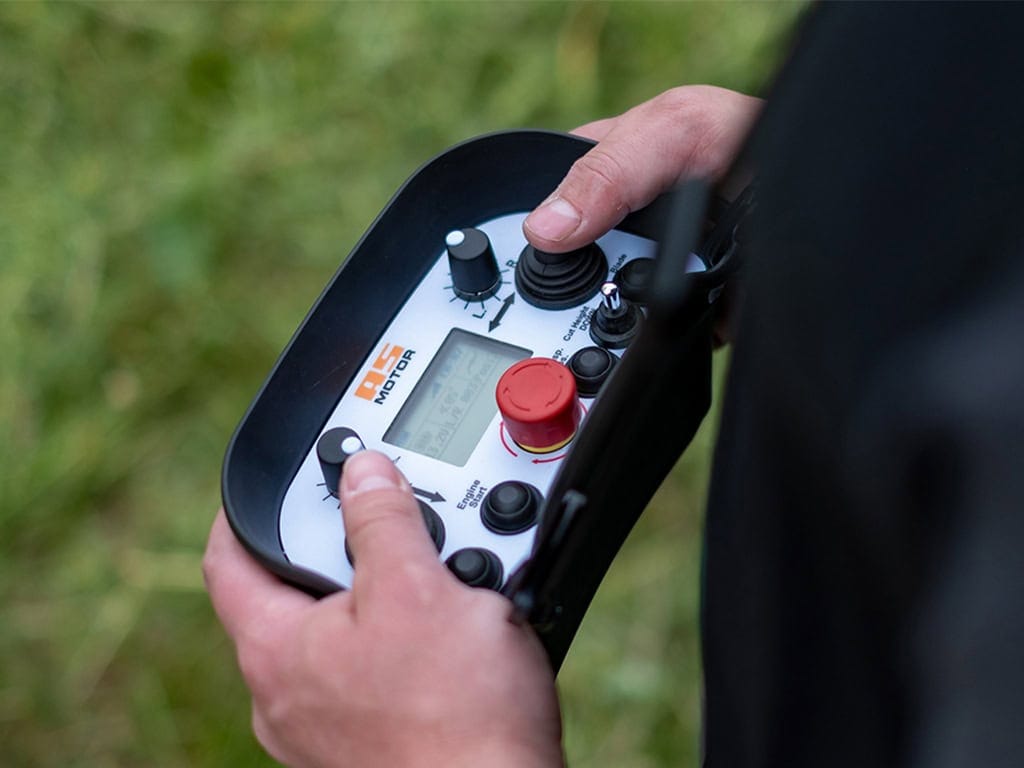
With the AS 990 Tahr RC, the operator remains outside the machine and controls it remotely. This allows them to adapt their position to the situation at hand and avoids the need to drive a ride-on mower into the slope themselves.
According to current AS-Motor product information, the AS 990 Tahr RC is designed for inclines of up to 56°. However, for the Braunfels works department, it was not a theoretical maximum value that was decisive, but rather the machine’s ability to safely and controllably maintain the existing embankments under real-world conditions.
Mayor Christian Breithecker describes the background to the purchase from the city’s perspective:

Anyone who knows our city will understand: Braunfels is not flat. Steep slopes and difficult terrain are part of our daily reality – and, until now, among the biggest challenges for our works department. With the new mowing crawler, we protect our employees while ensuring our city remains well-maintained and safe. This is an investment that pays off in every respect.
The situation in Braunfels thus reflects a challenge familiar to many municipal works departments. Maintenance areas do not disappear just because staffing is limited or certain slopes are difficult to manage with existing equipment. New technology must therefore address specific bottlenecks in the workflow or in workplace safety.
Fewer turning manoeuvres save time where it actually matters
In addition to the safety aspect, the city also cites a noticeable time saving in ongoing maintenance work. Several factors contribute to this. According to the city, the AS 990 Tahr RC can be transported and put into operation with minimal effort; on suitable areas, the bidirectional mower deck also reduces the number of turning manoeuvres.
The exact time saved over a full season in Braunfels has not been measured, so a percentage figure would not be reliable. However, the difference in the workflow is clearly tangible: at the end of a mowing pass, the operator does not need to turn the crawler completely around but can continue working in the opposite direction.
AS-Motor states that, under suitable conditions, the Tahr RC can achieve a maximum area performance of up to 4,500 m² per hour. How much of this can be achieved on a specific municipal area depends on factors such as vegetation density, slope gradient, soil conditions and obstacles. This is precisely why the demonstration in Braunfels was more informative than a pure comparison of technical performance data.
For the works department, the goal was not to achieve the highest theoretical value. What mattered was whether the machine could enable a safer and more efficient workflow on their own problem areas.
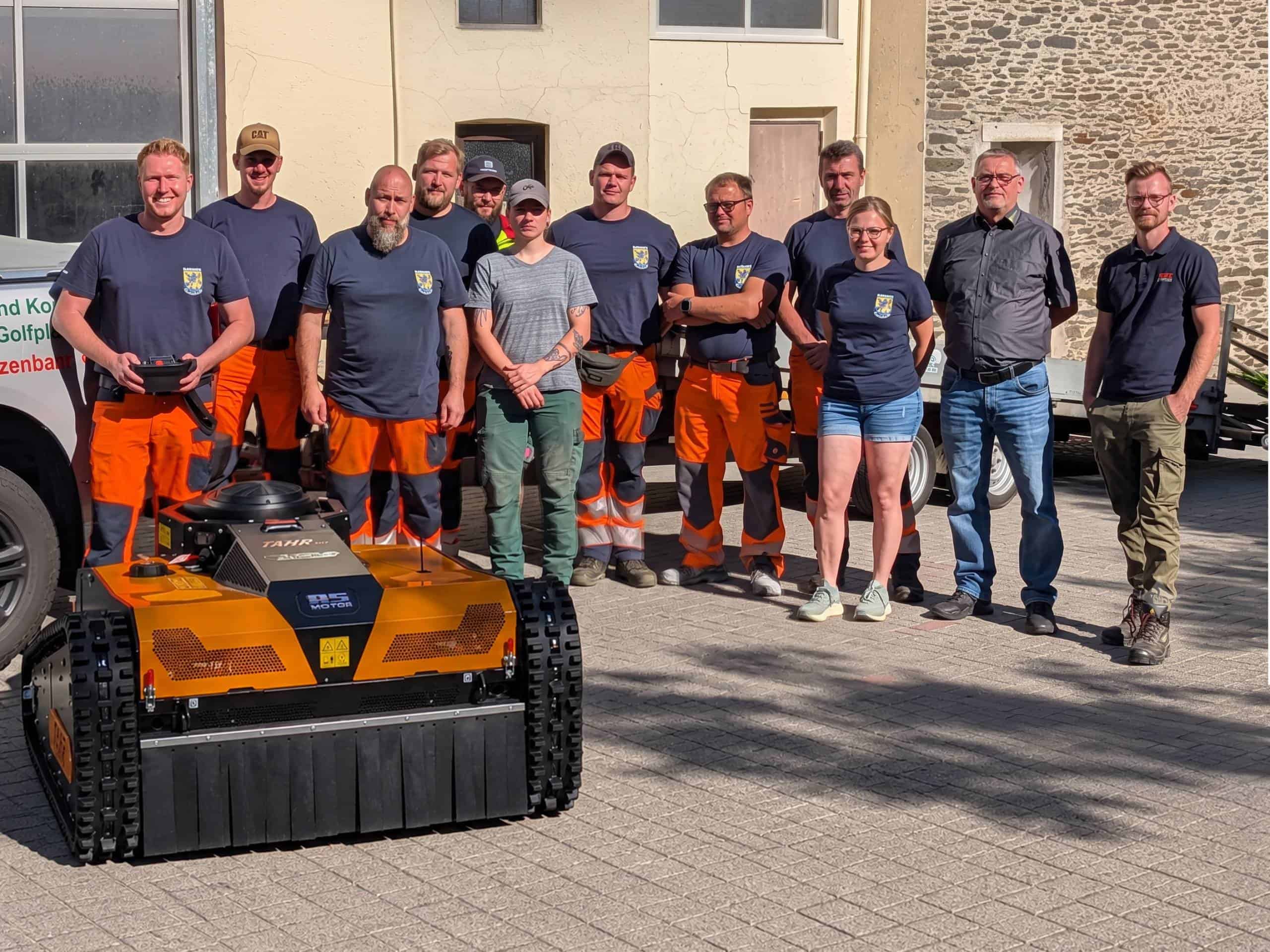
In July 2026, the mowing crawler was handed over to the works department
Following a successful demonstration, the decision was made in favour of the AS 990 Tahr RC, with the order processed through Weimer. In July 2026, the machine was finally handed over to the city of Braunfels.
Steffen Portz, head of the municipal works department, and his team took delivery of the new tracked mower. Nico Thiel from AS-Motor was on site, while Stefan Hergesell represented the specialist dealer Weimer. The handover was followed by training for the municipal works team, enabling staff to use the new machine in day-to-day operations immediately afterwards. The handover was covered in this article.
For Thiel, this marked the conclusion of a process that had begun around four years earlier with the first demonstration on a challenging slope. The core question had remained the same, but the technical solution had evolved. The municipal works department was still looking for a safe way to maintain its steep areas, but could now also rely on a machine concept that reduced the frequent turning manoeuvres observed during the earlier demonstration.
The castle embankment was the test case, not the only area of use
The slope near the castle played a central role in selecting the machine, but the AS 990 Tahr RC was not purchased exclusively for this one area. The city also cites road embankments, parks and hard-to-access green spaces within the urban area as additional applications.
This means the tracked mower complements the municipal works department’s existing fleet in areas where other equipment is less suitable due to gradient, accessibility or working method. This is also where the economic logic of such a specialist machine lies. It does not need to handle every mowing task in the city, but rather to maintain those areas more efficiently and safely that previously required disproportionately high effort.
For municipalities looking for a slope mower, embankment mower or remote-controlled tracked mower, this distinction is important. A machine that achieves high area performance on open green spaces is not necessarily the right solution for a steep road embankment or a winding slope. Similarly, a maximum gradient specification alone does not indicate how well a machine will integrate into an existing maintenance process.
Braunfels had the advantage of already being familiar with the challenging areas and their issues from daily operations. This allowed the city to define its requirements for the new technology more precisely, rather than starting from a specific product.
The area should determine the machine type
The case of Braunfels therefore demonstrates how a sensible selection of mowing technology for difficult municipal areas can be made. The starting point was not a product category, but a specific work situation: steep embankments, dense vegetation, frequent turning manoeuvres and the question of how employees could work more safely in such conditions.
These factors combined to define the machine’s requirements. The first demonstration had already shown the advantages of remote control on slopes and where the existing workflow still had room for improvement. During the follow-up demonstration four years later, the municipal works department was able to test these exact points under real-world conditions.
While this does not provide a universal machine recommendation for other municipalities, it does outline a logical decision-making process. Slope gradient and vegetation must be considered, as well as the layout of the area, access, transport and the operator’s position during work. Even the question of how often a machine needs to turn or manoeuvre can have a significant impact on available working time, especially on larger embankments.
Municipalities maintaining similar steep slopes, road embankments or hard-to-access green spaces can use the AS-Motor dealer search to find a specialist dealer for advice or a demonstration. Specific questions about a planned application can also be directed to the team via the AS-Motor contact form.